
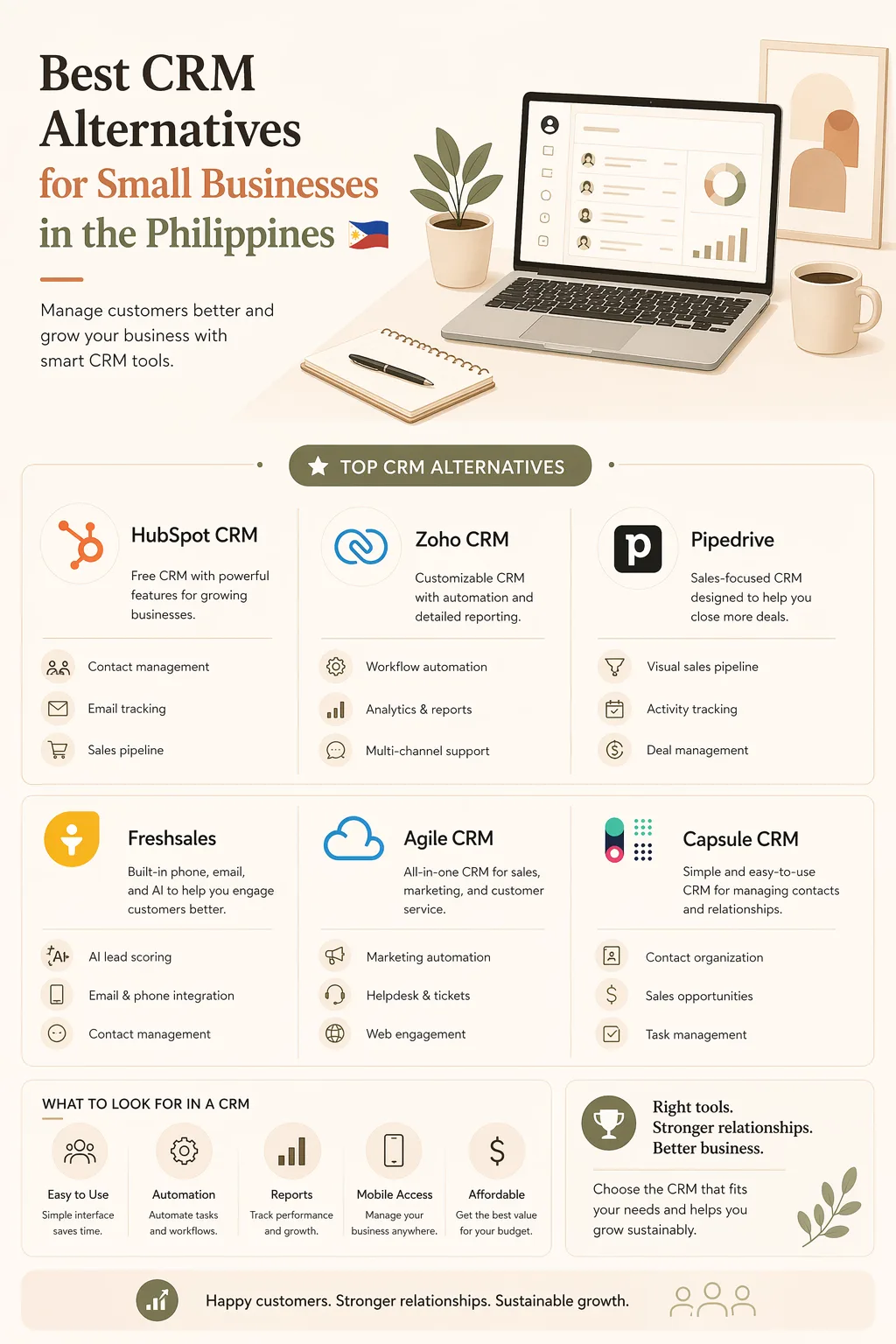
Best CRM Alternatives for Small Businesses in the Philippines
If you’re searching for CRM alternatives for small business Philippines teams can actually use, you’re probably dealing with one of two problems: the current CRM is too expensive, or it’s too complicated for a small sales team to maintain.
That’s common. Many small businesses do not need a massive enterprise CRM with advanced automation, multi-layer permissions, and long onboarding. They need something simpler: a tool for tracking leads, following up on inquiries, assigning tasks, and closing sales without wasting time.
This guide helps you compare practical CRM alternatives based on cost, ease of use, and fit for Filipino small businesses.
Why small businesses look for CRM alternatives
Most users start looking for alternatives when their current CRM becomes harder to justify. The usual reasons are:
- The pricing grows too fast as the team expands
- The interface feels too technical for non-technical staff
- Setup takes too long for a small sales team
- Important features are locked behind higher plans
- The CRM is built for enterprise teams, not small businesses
For many Philippine businesses, especially startups, agencies, online sellers, service businesses, and local distributors, a lighter tool can be a better match.
What to look for in a CRM alternative
Before comparing tools, define what your team actually needs. A good alternative should help you do the basics well.
Must-have features
- Contact and lead management
- Deal or pipeline tracking
- Task reminders and follow-ups
- Simple reporting
- Shared inbox or team collaboration if needed
- Mobile access for on-the-go work
Nice-to-have features
- Email integration
- Forms or lead capture
- Automation for repetitive tasks
- WhatsApp or chat integration
- Invoicing or payment connections
- Local currency-friendly pricing
Things to avoid
- Overly complex dashboards
- Hidden upgrade costs
- Features you will not use
- Tools that require a dedicated admin just to manage
Quick comparison: popular CRM alternative types
| Option type | Best for | Strengths | Trade-offs |
|---|---|---|---|
| Simple sales CRM | Small teams that want easy lead tracking | Easy setup, affordable, quick adoption | Fewer advanced automation features |
| Project-management tool with CRM features | Agencies and service businesses | Combines tasks, clients, and deals | CRM features may be basic |
| Spreadsheet-based workflow | Very small teams or early-stage businesses | Low cost, flexible, familiar | Manual, harder to scale |
| All-in-one business platform | Teams that want CRM plus other tools | Broader features in one system | Can still be complex or pricey |
Best CRM alternatives for small businesses in the Philippines
Below are the types of alternatives that are often a better fit than a heavy CRM suite.
1. Simple CRM tools
These are usually the best choice if your main goal is to track leads, manage follow-ups, and monitor sales progress.
Good for:
- Small sales teams
- Freelancers with client pipelines
- Local service businesses
- Startups that need structure without complexity
Why choose it:
- Easier to learn
- Faster to deploy
- Usually lower monthly cost than enterprise CRMs
Watch out for:
- Limited automation
- Fewer customization options
2. Project management tools with client tracking
Some teams do not need a full CRM. They need a place to manage client work, tasks, and communication in one place.
Good for:
- Agencies
- Design teams
- Marketing freelancers
- Small service businesses
Why choose it:
- Helps organize work and client delivery
- Easier for teams already using task boards
- Can reduce tool sprawl
Watch out for:
- Deal tracking may not be as strong as dedicated CRMs
3. Spreadsheet-based CRM systems
A well-structured spreadsheet can work surprisingly well for early-stage businesses.
Good for:
- Very small teams
- Solo founders
- Businesses validating their sales process
Why choose it:
- Low cost
- Familiar to most users
- Easy to customize
Watch out for:
- Manual updates
- Risk of errors
- Harder to scale when lead volume grows
4. All-in-one business tools
Some businesses prefer one platform for sales, email, customer tracking, and operations.
Good for:
- Teams that want fewer subscriptions
- Businesses needing sales plus workflow tools
- Owners who want a single login for multiple functions
Why choose it:
- Consolidates tools
- Can be more efficient than separate apps
Watch out for:
- You may still pay for features you do not need
- Some all-in-one tools become bulky quickly
How to choose the right alternative for your business
Use this simple decision guide.
Choose a simple CRM if:
- You need lead tracking and follow-up reminders
- Your team is small
- You want a faster setup
- You want your staff to adopt the tool quickly
Choose a project tool with CRM features if:
- Your sales work is closely tied to delivery
- You manage clients and tasks in the same workflow
- You care more about organization than advanced sales automation
Choose a spreadsheet workflow if:
- You are still early-stage
- Your lead volume is low
- You want a free or very low-cost starting point
Choose an all-in-one platform if:
- You want to reduce the number of tools your team uses
- You need sales plus other business workflows
- You are okay with a more complex setup
Practical tips for Filipino small businesses
A CRM alternative should fit your real operating conditions, not just feature lists.
Consider these local realities
- Your team may work remotely or on mobile most of the time
- Some staff may prefer tools that are easy to learn quickly
- You may want pricing that scales slowly
- You may need tools that work well for chat-driven sales workflows
- You may want simple reporting for daily follow-up and closing
Ask before you buy
- Can my team learn this in one day?
- Does it solve our current sales problem?
- Is the monthly cost sustainable for us?
- Will we actually use the advanced features?
- Can we switch later if needed?
When a cheaper CRM is not enough
A lower-cost tool is not always the best answer. If your team has:
- Multiple sales pipelines
- Complex approval steps
- Large lead volumes
- Advanced automation needs
- A dedicated sales operations team
…then a more robust CRM may still be the better option.
The key is not to overbuy early. Many small businesses pay for enterprise-grade software when they only need a lightweight sales system.
Final thoughts
The best crm alternatives for small business philippines teams depend on how you sell, how many people use the tool, and how much complexity you can realistically handle.
If your current CRM feels too expensive or too hard to manage, start by comparing simpler sales tools, project-based workflows, and lightweight business platforms. The right alternative is the one your team will actually use every day.
If you want to compare tools, pricing, and simpler alternatives side by side, check RPAMZ for practical software comparisons made for Filipino businesses.
FAQ
What is the best CRM alternative for a small business in the Philippines?
The best option depends on your workflow. If you only need lead tracking and follow-ups, a simple CRM is usually best. If you manage client work and tasks together, a project management tool with CRM features may be enough.
Are spreadsheets a good CRM alternative?
Yes, for very small teams or early-stage businesses. They are affordable and flexible, but they require manual updates and can become hard to manage as your business grows.
Why do small businesses switch from CRM tools?
The most common reasons are cost, complexity, and low team adoption. Many businesses want something simpler and easier to maintain.
Can a project management tool replace a CRM?
Sometimes. If your sales process is simple and closely tied to client delivery, it can work. But if you need strong pipeline tracking and sales reporting, a dedicated CRM is usually better.
How do I choose a CRM alternative without wasting money?
Start with your must-have features, test the tool with one workflow, and avoid paying for advanced features you do not need. Look for something your team can use quickly and consistently.