Best HR Software in the Philippines for SMEs and Growing Teams
Choosing the best HR software in the Philippines depends on how your team handles hiring, employee records, attendance, payroll, and compliance tasks. For small and growing businesses, the right tool should reduce manual work, keep employee data organized, and make payroll and timekeeping easier to manage.
This guide compares practical HR software options and explains what Filipino businesses should look for before buying.
What HR software should do for a Philippine business
For many SMEs, HR work is still spread across spreadsheets, chat apps, and paper files. That becomes hard to manage once headcount grows.
A good HR platform should help with:
- Recruitment and onboarding
- Employee database and records management
- Attendance and timekeeping
- Leave tracking
- Payroll workflows
- Approvals and document handling
- Basic reporting for management
If your business has hourly workers, field staff, or a hybrid setup, attendance and payroll integration become especially important.
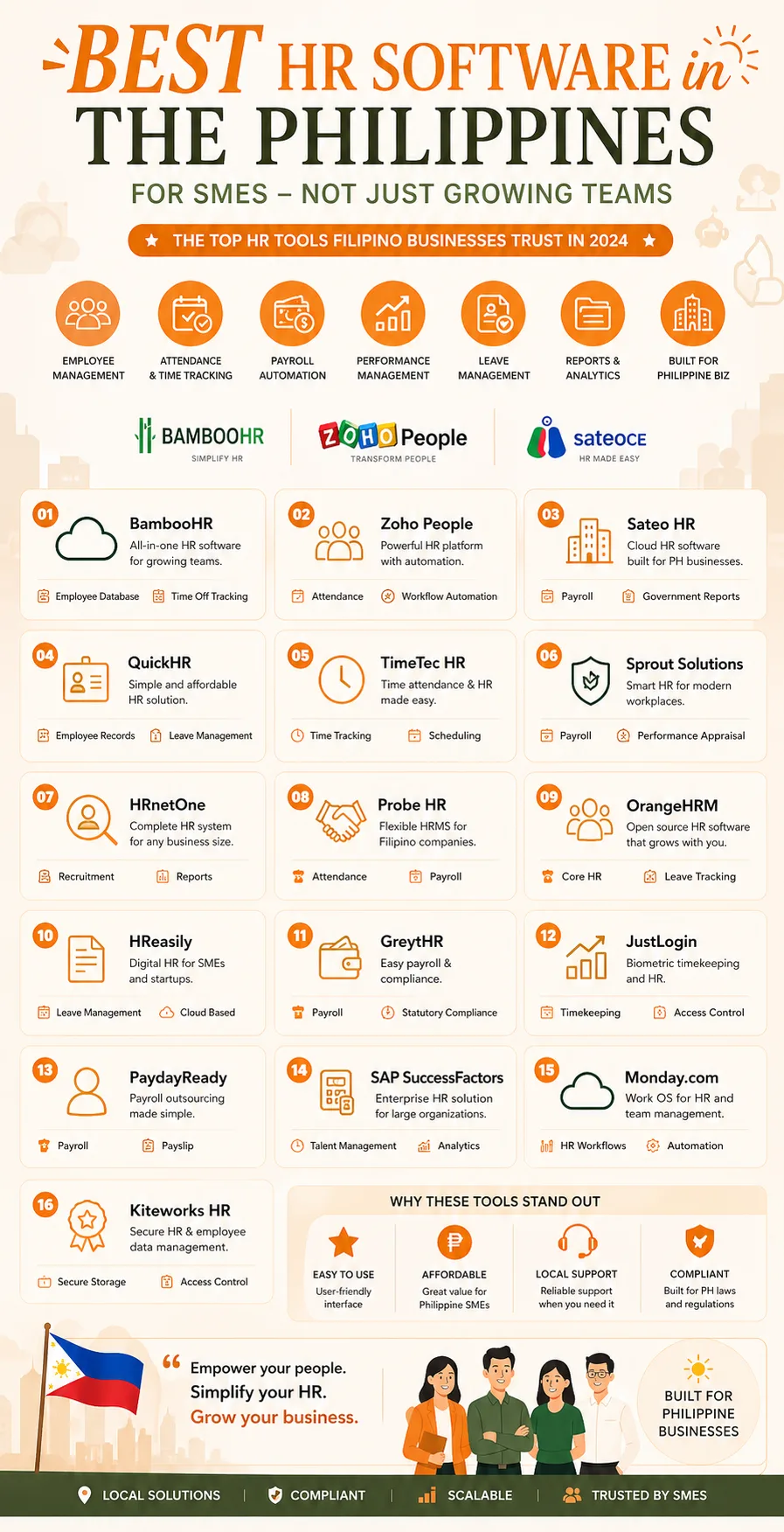
Quick comparison of popular HR software options
| Tool | Best for | Strengths | Watch out for |
|---|---|---|---|
| BambooHR | Growing teams that want an easy HR system | Clean interface, employee records, onboarding, reporting | Payroll may require integrations depending on location |
| Zoho People | SMEs that want flexible HR workflows | Attendance, leave, approvals, customizable processes | Can feel complex if you only need basic HR features |
| Keka | Teams that want HR plus attendance and payroll support | Strong time tracking, HR workflows, payroll-oriented setup | Best if you need the full suite; may be more than very small teams need |
| monday.com | Teams that want flexible HR process tracking | Custom workflows for hiring and onboarding | Not a dedicated HR system out of the box |
| OrangeHRM | Businesses looking for a modular HR platform | Core HR, leave, attendance, recruitment modules | Setup and configuration may take more effort |
| SAP SuccessFactors | Larger companies with advanced HR needs | Enterprise-grade HR management | Usually too heavy for most SMEs |
Best HR software in the Philippines: our practical picks
1. BambooHR
BambooHR is a strong choice for SMEs and growing teams that want a simple, polished HR system. It works well for employee records, onboarding, approvals, and reporting.
Best for:
- Companies with growing headcount
- Teams that want a user-friendly HR dashboard
- Businesses that need clean employee records and onboarding
Why it stands out:
- Easy to use
- Good for centralizing employee information
- Useful for managers and HR teams who want less admin work
Possible limitation:
- Payroll features may depend on integrations and local setup
2. Zoho People
Zoho People is a flexible HR platform that suits SMEs with more detailed workflows. It can handle attendance, leave, approvals, performance-related tasks, and employee data.
Best for:
- Businesses that want configurable HR workflows
- Teams with attendance and leave complexity
- Companies already using Zoho apps
Why it stands out:
- Flexible setup
- Solid attendance and leave tools
- Good fit for businesses that want automation
Possible limitation:
- Setup may take time if your team only needs the basics
3. Keka
Keka is well known for combining HR, attendance, and payroll-oriented workflows. It can be a good fit for businesses that want a more complete people operations system.
Best for:
- Growing teams with attendance-heavy operations
- Businesses that want HR and payroll support in one place
- Companies managing employees with different shifts or work arrangements
Why it stands out:
- Strong time and attendance features
- Useful for workforce-heavy businesses
- Good for structured HR processes
Possible limitation:
- May be more feature-rich than a very small team needs
4. OrangeHRM
OrangeHRM is a modular HR system that can work well for businesses that want to build their HR stack step by step. It covers core HR, leave, attendance, and recruitment modules.
Best for:
- SMEs that want control over which modules they use
- Teams looking for a customizable HR platform
- Businesses with internal admins who can manage setup
Why it stands out:
- Modular approach
- Good coverage of essential HR functions
- Flexible for different business structures
Possible limitation:
- Configuration may require more effort than plug-and-play tools
5. monday.com for HR workflows
monday.com is not a dedicated HR software, but it can work for companies that want to build hiring pipelines, onboarding checklists, and approval workflows.
Best for:
- Small teams with simple HR processes
- Businesses already using monday.com for operations
- Teams that want flexible workflow tracking
Why it stands out:
- Highly customizable
- Great for process visibility
- Easy to adapt for hiring and onboarding
Possible limitation:
- Not a full HR system unless paired with other tools
How to choose the right HR software in the Philippines
When comparing tools, focus on practical use rather than features you may never use.
1. Check if it fits your team size
A 10-person team and a 100-person team have very different needs. Smaller teams usually need simplicity. Growing teams need stronger workflows, roles, and reporting.
2. Prioritize payroll and attendance if your team is operational
If your employees work shifts, are paid hourly, or submit timesheets, attendance tracking should be a top priority. Payroll becomes easier when timekeeping is accurate.
3. Look for an employee record system
Your HR software should make it easy to store contracts, personal data, job details, and documents in one place.
4. Think about onboarding and hiring
If you hire often, choose software that supports recruitment stages, offer tracking, onboarding checklists, and document collection.
5. Ask about integrations
Many companies already use accounting tools, communication apps, or payroll systems. Make sure the HR software can connect with the tools you already have.
6. Consider ease of use
The best system is the one your team will actually use. A cleaner interface can matter more than a long feature list.
Common HR workflows Filipino SMEs need
Many local businesses usually need software for these workflows:
- Hiring: track applicants and interview stages
- Onboarding: collect employee information and documents
- Attendance: record time in, time out, and shifts
- Leave management: manage vacation, sick leave, and approvals
- Payroll preparation: organize attendance and salary inputs
- Employee file management: store records in one system
If your current process uses too many spreadsheets, that is usually a sign it is time to switch.
Recommended setup by business type
For a small office team
Choose a simple HR platform like BambooHR or Zoho People if you want employee records, onboarding, and leave management without too much complexity.
For shift-based teams
Look for a system with stronger attendance tools, such as Keka or OrangeHRM.
For process-driven startups
If your HR process is still evolving, monday.com may work for hiring and onboarding workflows, especially if you need a customizable setup.
For larger or fast-scaling organizations
If your business needs deeper HR structure, SAP SuccessFactors may be worth evaluating, but it is usually more suitable for enterprise-level requirements.
Final thoughts
The best HR software in the Philippines is the one that matches your team size, workflow, and budget. For most SMEs, the smartest choice is usually a tool that combines employee records, attendance, leave, and payroll preparation in one place.
Start with your daily pain points: hiring, documents, timekeeping, or payroll. Then compare the tools that solve those problems most directly.
If you want to compare HR software side by side and find better alternatives for your business, check out RPAMZ for practical software comparisons built for Filipino teams.
FAQ
What is the best HR software in the Philippines for SMEs?
There is no single best option for every business. BambooHR, Zoho People, Keka, and OrangeHRM are common choices depending on whether you need simplicity, flexibility, or stronger attendance and payroll workflows.
Do Filipino businesses need HR software with payroll?
Not always, but payroll support is helpful if your team has hourly workers, shift schedules, or frequent attendance adjustments. It reduces manual work and helps keep payroll inputs organized.
Can HR software help with attendance and leave tracking?
Yes. Many HR tools include timekeeping, leave requests, approval workflows, and attendance reports. These features are important for SMEs with operational teams.
Is there HR software for startups and small teams?
Yes. Small teams can use simpler platforms for employee records, onboarding, and leave management. If your needs are basic, you do not need an enterprise system.
What should I compare before buying HR software?
Compare pricing, ease of use, employee records, attendance, leave management, payroll support, integrations, and reporting. Also check whether the software fits your current team size and future growth.