
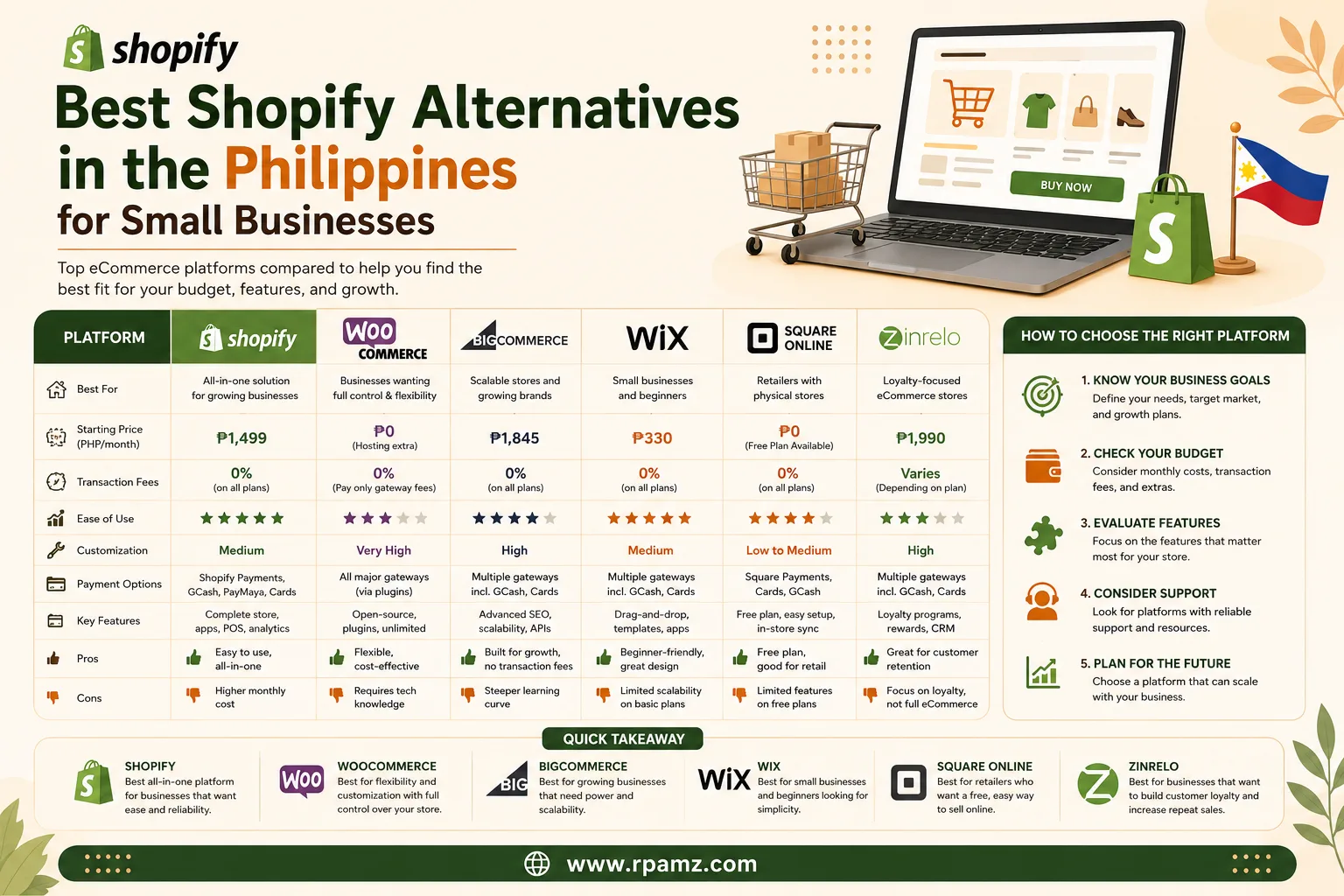
Best Shopify Alternatives in the Philippines for Small Businesses
If you are looking for Shopify alternatives in the Philippines, you are probably trying to solve one of three problems: Shopify feels too expensive, too advanced for your current needs, or not flexible enough for the tools and payment methods you want to use.
For many Filipino small businesses, the best ecommerce platform is not the most popular one — it is the one that is easiest to manage, affordable to maintain, and practical for local selling.
This guide compares the best Shopify alternatives for Philippine sellers, especially if you want something cheaper, simpler, or more local-friendly.
Quick comparison of Shopify alternatives
| Platform | Best for | Starting cost | Ease of use | Local-friendly notes |
|---|---|---|---|---|
| WooCommerce | Sellers who want flexibility and control | Low to moderate | متوسط | Good if you already use WordPress and want more customization |
| Wix eCommerce | Beginners who want an all-in-one site builder | Low to moderate | Easy | Good for simple stores and service businesses |
| BigCommerce | Growing businesses with larger catalogs | Moderate | Moderate | Strong built-in ecommerce features, but may feel heavier |
| Squarespace Commerce | Brands that want polished design | Moderate | Easy | Great for content-driven brands and visual products |
| Ecwid | Sellers who want to add a store to an existing website | Low to moderate | Easy | Good for lightweight selling and simple setup |
| Shopee / Lazada store | Marketplace-first sellers | Low to moderate | Easy | Strong local reach, but you do not fully own the customer experience |
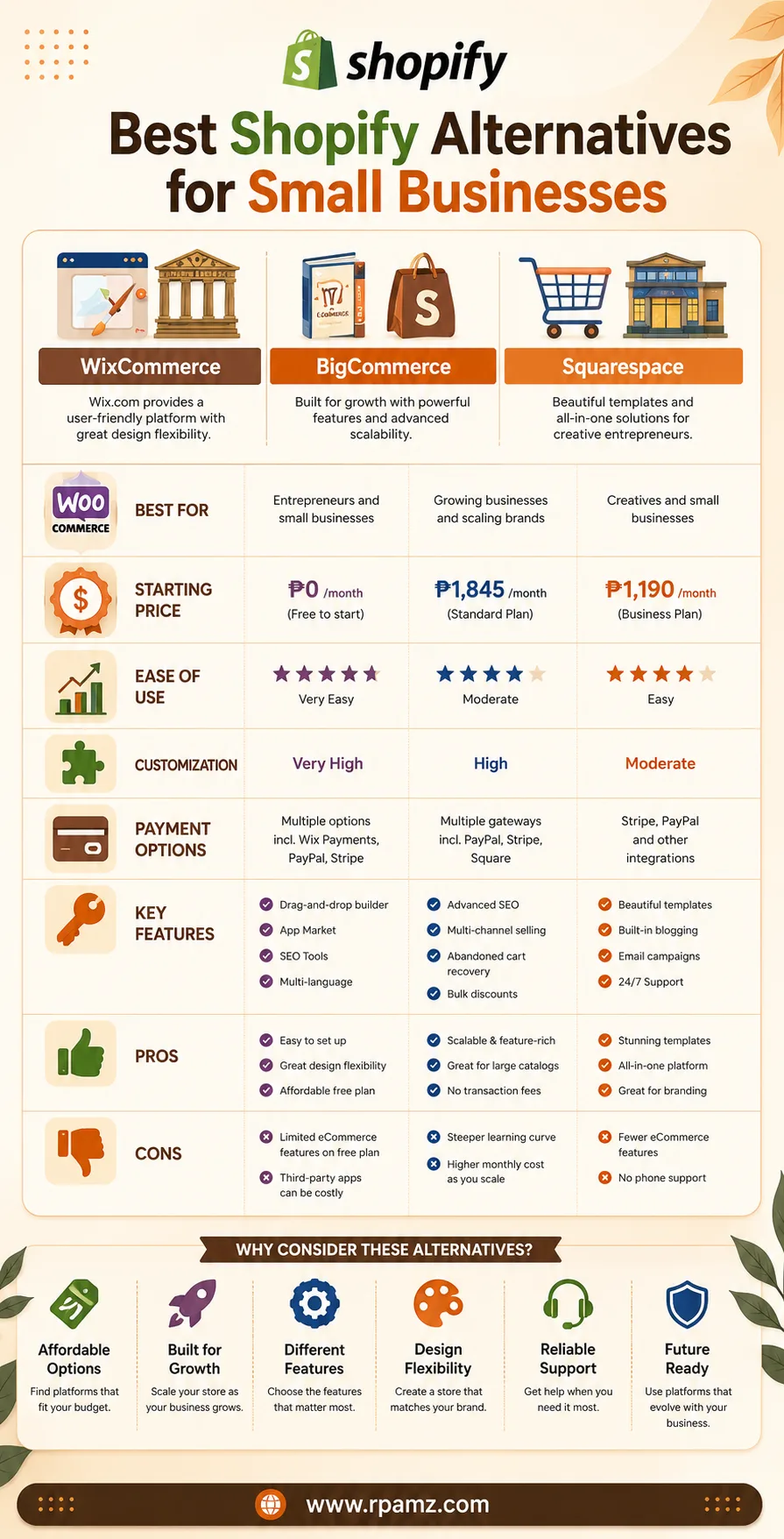
Why Filipino businesses look for Shopify alternatives
Shopify is a strong platform, but it is not always the best fit for every Filipino seller. Common reasons people search for alternatives include:
- Lower monthly cost
- Easier setup for first-time sellers
- Better fit for small catalogs
- More control over design and checkout flow
- Preference for a website they fully own
- Need to pair with local selling channels and social commerce
If you are running a side hustle, a home-based business, or a growing brand in the Philippines, you may not need a heavy ecommerce stack right away.
Best Shopify alternatives in the Philippines
1. WooCommerce
Best for: WordPress users who want flexibility and lower long-term cost
WooCommerce is one of the most popular Shopify alternatives because it turns a WordPress website into an online store. If you already have a WordPress site, this can be a cost-effective way to start selling.
Pros:
- Flexible and highly customizable
- Large plugin ecosystem
- Good for content + ecommerce combinations
- You control your own website and data
Cons:
- Needs hosting, maintenance, and setup
- Can become complex as your store grows
- Extra plugins may add cost
Good fit for Filipino sellers:
- Businesses that already use WordPress
- Product-based brands that also publish blogs
- Sellers who want more control and less platform lock-in
2. Wix eCommerce
Best for: Beginners who want an easy all-in-one website builder
Wix is a user-friendly option for small businesses that want to launch quickly without dealing with too many technical tasks. It is especially useful if your store is simple and you want to manage everything in one place.
Pros:
- Easy drag-and-drop editing
- Built-in website and ecommerce tools
- Good templates for small businesses
- Faster to launch than more technical platforms
Cons:
- Less flexible than WordPress + WooCommerce
- Can feel limiting for advanced ecommerce needs
- Plan costs can rise as you add features
Good fit for Filipino sellers:
- New business owners
- Service businesses that also sell products
- Small catalogs and simple storefronts
3. BigCommerce
Best for: Growing businesses that need stronger native ecommerce features
BigCommerce is a serious ecommerce platform with many built-in features. It can be a good Shopify alternative if you want a more robust store without relying too much on apps.
Pros:
- Strong ecommerce features out of the box
- Good for scaling catalogs
- Useful built-in tools
- Less dependency on third-party apps than some competitors
Cons:
- Can feel more advanced than small sellers need
- Pricing may not suit very early-stage businesses
- Setup may be heavier than simpler builders
Good fit for Filipino sellers:
- Brands with growing inventory
- Businesses planning to scale beyond a basic store
- Teams that want more built-in ecommerce functionality
4. Squarespace Commerce
Best for: Brands that prioritize design and storytelling
Squarespace is a great choice if you want your store to look polished and professional with minimal design work. It is often used by creative brands, boutiques, and visually driven businesses.
Pros:
- Beautiful templates
- Easy to manage
- Good for brand presentation
- Combines content and ecommerce well
Cons:
- Less flexible than WooCommerce
- Not ideal for highly complex stores
- Limited advanced ecommerce customization compared with specialized platforms
Good fit for Filipino sellers:
- Fashion, beauty, lifestyle, and handmade brands
- Businesses that rely on visual branding
- Sellers who want a simple, elegant store
5. Ecwid
Best for: Sellers who want to add ecommerce to an existing site
Ecwid is useful if you already have a website and just want to add a shop without rebuilding everything. It is lightweight and practical for smaller businesses.
Pros:
- Easy to add to an existing site
- Simple to set up
- Good for small product catalogs
- Flexible for multi-channel selling
Cons:
- Less powerful than full ecommerce platforms for bigger stores
- May feel limited for advanced customization
- Best suited for smaller operations
Good fit for Filipino sellers:
- Businesses with an existing website
- Small shops testing online sales
- Entrepreneurs who want a quick ecommerce layer
6. Marketplace stores: Shopee and Lazada
Best for: Sellers who want local traffic and ready-made audiences
If your priority is selling quickly in the Philippines, marketplaces may be a more practical starting point than building a standalone store. Shopee and Lazada give you access to built-in traffic and familiar checkout behavior for local buyers.
Pros:
- Built-in audience
- Familiar to Filipino shoppers
- Easier to start than a full standalone store
- Can support fast validation of product demand
Cons:
- Less brand control
- Fees and platform rules apply
- Harder to build a direct customer relationship
- Competition can be intense
Good fit for Filipino sellers:
- New sellers testing product-market fit
- Brands focused on volume and visibility
- Businesses that want to start without a full website build
Which Shopify alternative should you choose?
Here is a simple way to decide:
- Choose WooCommerce if you want control, flexibility, and long-term ownership.
- Choose Wix if you want the easiest setup.
- Choose BigCommerce if you expect to scale and need stronger ecommerce tools.
- Choose Squarespace if design matters a lot.
- Choose Ecwid if you already have a website and just need a store.
- Choose Shopee or Lazada if you want quick access to Filipino buyers.
Things Filipino sellers should check before choosing a platform
Before you commit, compare these practical factors:
Payment options
Make sure the platform supports the payment methods your customers actually use. For Philippine buyers, that often means a mix of cards, bank transfers, e-wallets, and cash-on-delivery workflows where applicable.
Shipping setup
Check whether it is easy to configure shipping rates, delivery zones, and courier integrations.
Mobile usability
Many Filipino customers shop on mobile, so your storefront should be easy to browse on a phone.
Ease of maintenance
A platform is only “cheap” if you can manage it without needing constant help.
Total cost
Look beyond the monthly fee. Consider hosting, apps, themes, payment fees, and design costs.
Local selling strategy
If you plan to sell on social media, marketplaces, and your own website, choose a platform that fits that multichannel workflow.
Best use cases by business type
For side hustles and solo sellers
Start with Wix, Ecwid, or marketplace stores if you want a simple launch.
For WordPress-based businesses
WooCommerce is usually the strongest choice if you already have a WordPress site.
For brand-led stores
Squarespace is worth considering if presentation is a priority.
For scaling ecommerce brands
BigCommerce may be a better long-term fit if you expect larger catalogs and more operational needs.
Final thoughts
The best Shopify alternative in the Philippines depends on your budget, technical comfort, and sales strategy. If you want maximum control, WooCommerce is hard to beat. If you want simplicity, Wix or Ecwid may be enough. If you want to reach buyers quickly, marketplaces like Shopee and Lazada are still important options for Filipino sellers.
The smartest move is to compare platforms based on your actual business stage, not just on popularity.
If you want to explore more options and compare tools side by side, check RPAMZ for practical software comparisons and alternatives that fit Filipino businesses.
FAQ
Is Shopify expensive for small businesses in the Philippines?
Shopify can become expensive once you factor in monthly fees, apps, themes, and possible payment costs. For small businesses, the total cost may feel high if you only need basic ecommerce features.
What is the cheapest Shopify alternative?
The cheapest option depends on your setup. WooCommerce can be cost-effective if you already have WordPress, while marketplaces may be cheaper to start because you do not need to build a standalone store from scratch.
What is the easiest Shopify alternative for beginners?
Wix and Ecwid are often easier for beginners because they are simpler to launch and manage than more technical platforms.
Is WooCommerce better than Shopify for Filipino sellers?
WooCommerce can be better if you want more control and already use WordPress. Shopify may still be easier for some users, but WooCommerce is often more flexible for businesses that want ownership and customization.
Can I sell in the Philippines without Shopify?
Yes. Many Filipino sellers use WooCommerce, Wix, Squarespace, Ecwid, Shopee, Lazada, or a combination of these tools.
Which platform is best for a small online store in the Philippines?
For many small stores, WooCommerce, Wix, and marketplace stores are the most practical starting points. The best choice depends on whether you want a website, a marketplace presence, or both.