
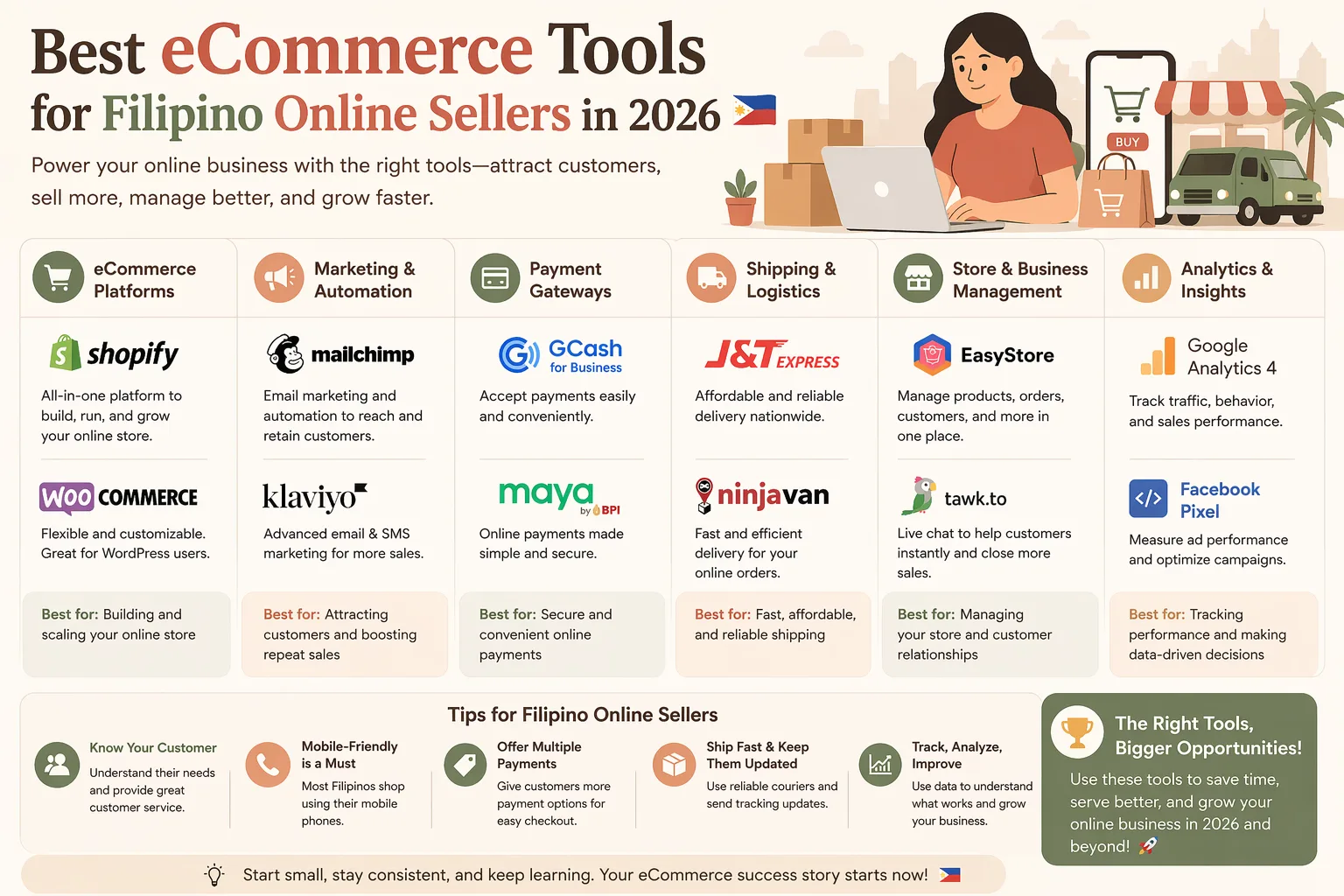
Best eCommerce Tools for Filipino Online Sellers in 2026
Filipino ecommerce is genuinely booming, and choosing the right ecommerce tools in the Philippines is where most sellers either gain an edge or lose months to trial and error. The typical experience goes like this: two to three months testing tools that don't accept GCash, can't sync with Shopee, or quote shipping rates in USD, before landing on a setup that actually works. That phase is brutal, and it costs real money. This guide cuts through it. It covers the five tool categories every Filipino online seller needs in 2026, from picking your store platform to marketing automation, and closes with a concrete stack-building checklist so you can move fast instead of Googling your way to burnout. If you want the shortlisting work already done, RPAMZ Tools Directory has curated ecommerce tool collections built specifically for the Philippine market, with verified reviews and exclusive discount codes you won't find anywhere else.
Marketplace vs. standalone store: which one should you start with?
This is the foundational decision that shapes every other tool choice. Get it wrong and you'll fight your platform for years. The answer depends on where you are in your business right now, not where you want to be eventually.
Shopee and Lazada: what they give you and what they take
Shopee pulls around 72 million monthly visitors and commands about 46% of Philippine ecommerce market share. Lazada sits at roughly 37 million monthly visitors and is especially trusted for electronics and branded goods. Both give you instant traffic, built-in logistics networks, and local payment acceptance without any setup work on your end. The trade-off is real: commissions run between 2.5% and 5% depending on category, branding options are minimal, and your visibility lives and dies by the platform's algorithm. TikTok Shop is worth watching too, particularly if your product lends itself to creator-led or video-first selling.
When a standalone store makes more sense
Self-hosted stores earn their place once you have a loyal customer base, need full brand control, or sell outside the Philippines. Prosperna is the locally-built option worth serious consideration: it has a free forever plan, native GCash and Maya support out of the box, J&T and Lalamove auto-booking built in, and Tagalog-language support for your customers. Shopify is powerful but starts at around $29 USD per month, bills in foreign currency, and requires extra plugins and setup costs to handle local payment methods and couriers properly. For most Filipino SMEs starting out, Prosperna's zero-cost entry and pre-integrated local stack is a genuine advantage.
The hybrid approach most Filipino sellers actually use
The setup that works for most sellers is straightforward: use Shopee and Lazada for discovery traffic and new customer acquisition, then direct repeat buyers to your own store for upsells and direct relationships. This approach keeps customer acquisition costs low while building an asset, your own store and email list, that no algorithm can take away. The multichannel ecommerce tools covered in Section 4 make managing both channels practical without doubling your workload.
Payment gateways Filipino shoppers trust, ecommerce tools Philippines sellers rely on
Payments are where most Philippine ecommerce setups quietly fall apart. A gateway that looks cheap on paper often has slow settlement times, missing wallet support, or no local customer service when something goes wrong. Know the landscape before you commit.
GCash and Maya: the non-negotiables
GCash and Maya are table stakes for Filipino buyers. They're not gateways themselves, they're acceptance methods your chosen gateway must support. HitPay is worth a close look: it charges 2.3% for GCash transactions and 1% for QR Ph payments, with no monthly fees or setup costs. PayMongo and Xendit both integrate cleanly with Shopify and WooCommerce and support e-wallet acceptance alongside card payments.
PayMongo, Xendit, and DragonPay compared
These three serve different use cases, and picking the wrong one creates friction later. PayMongo suits straightforward small stores that need quick setup with GCash, Maya, and card support. Xendit is better for volume merchants who need omnichannel API access and can negotiate rates. DragonPay is the go-to for subscription or recurring billing scenarios. Settlement timelines for most gateways run one to three business days for standard transfers, with near-instant options available through InstaPay and PhilPaSS Plus for real-time needs. For more on settlement timing, see payment settlement explained.
What to check before you commit to a gateway
Four things matter most and they're rarely front-page on provider websites: settlement speed, COD handling capability, chargeback fees, and whether the gateway has a local support team in the Philippines. PayPal, for instance, charges ₱500 per dispute, a cost that adds up fast if chargebacks aren't actively managed. A gateway with a 48-hour international support queue will cost you more in stress and lost sales than the slightly cheaper transaction rate was ever worth.
Shipping and logistics tools that won't let your customers down
According to industry data on Philippine ecommerce behavior, delayed orders and slow shipping are among the top reasons buyers abandon a seller permanently, with nearly half saying a single bad fulfillment experience is enough to make them stop purchasing. Logistics is not a place to cut corners or default to whatever Shopee suggests without thinking.
J&T, LBC, and Ninja Van: matching courier to your business type
J&T Express starts at around ₱190 for local parcels and integrates directly with Shopee and Lazada, making it the practical choice for high-volume nationwide sellers. LBC carries more trust for fragile or high-value shipments and has the widest physical branch network in the country. Ninja Van pairs well with Lazada's fulfillment network and offers consistent tracking that customers actually find useful. Delivery windows run one to three days for urban areas and three to five days for provincial destinations, though Mindanao deliveries can stretch longer depending on the courier and the specific municipality. For a consolidated reference on couriers you can integrate with your store, see this list of delivery couriers in the Philippines.
Lalamove and on-demand delivery for Metro Manila sellers
For same-day or instant delivery within Metro Manila, Lalamove is hard to beat. It has an official Shopify integration, 24/7 booking, and can handle bulky items that standard couriers won't accept. Grab Express covers similar ground but with a smaller service area outside NCR. If your buyers are concentrated in Metro Manila and expect same-day delivery, either works well as an add-on courier option. For more on Lalamove's ecommerce capabilities and API integration, see their guide to API integration for ecommerce in the Philippines.
COD management: the hidden operational cost
COD remains dominant in Philippine ecommerce, and managing remittances, failed deliveries, and returns manually is one of the fastest ways to destroy your margins. Most couriers like Ninja Van auto-remit COD funds on a set schedule with a handling fee of around 2.5% to 2.75% deducted. The key is connecting your courier dashboard to your order management system so reconciliation isn't a manual spreadsheet exercise at the end of every week. Platforms like Prosperna and StoreHub handle this connection natively.
Keeping inventory and orders synced across multiple channels
Most Filipino sellers skip multichannel sync until they oversell the same item on Shopee and their own store on the same weekend and spend the next two days issuing refund apologies. Once you're selling in more than one place, real-time inventory sync isn't optional.
Philippine ecommerce tools for connecting Shopee, Lazada, and your own store
Prosperna's built-in multichannel sync handles Shopee, Lazada, Facebook, and Instagram from one dashboard, a genuine advantage for sellers who don't want to manage five separate logins. StoreHub offers similar multichannel capabilities with POS functionality built in, which matters for sellers who blend online and physical sales. For Shopify users, the app store has marketplace integration options for Philippine platforms, though reliability varies and you'll want to check reviews specifically from Filipino merchants before committing. Real-time inventory deduction and centralized order dashboards are the two features that separate useful multichannel tools from ones that still create manual work.
Order management tools worth considering for growing sellers
StoreHub and Prosperna both include POS features that let you manage in-person and online sales from the same inventory pool. This matters more than it sounds: Filipino sellers who run a physical stall or pop-up alongside their online store often end up with duplicate inventory problems because their offline and online systems don't talk to each other. Solving that problem early saves significant headaches as order volume grows.
Marketing and automation tools that add real revenue
Most Filipino sellers underinvest in marketing tools until they hit a revenue ceiling that Shopee's built-in promos can't push through. The highest-ROI marketing channels for Philippine ecommerce don't require a large budget, they require the right tools, configured correctly from the start.
Email and SMS tools with local relevance
For standalone store owners, email and SMS deliver the best return on marketing spend for customer retention. Klaviyo integrates tightly with Shopify and handles segmentation, cart recovery, and post-purchase flows without requiring a dedicated marketing person to manage it. Omnisend is a solid free-start alternative with email and SMS combined in one tool. Bulk SMS works especially well in the Philippine market because mobile penetration is high and SMS open rates significantly outperform email for COD confirmation messages and cart recovery nudges. Make sure whatever SMS tool you use routes reliably through Globe and Smart networks.
Analytics and ad integrations that actually help you scale
Facebook Pixel and Google Analytics are the baseline, full stop. Prosperna has Google UTM tracking built in, which removes one more plugin from your setup checklist. For sellers running paid ads, the critical habit is connecting ad spend data back to actual orders placed, not just traffic or clicks. Meta's Commerce Manager and tools like ROI Hunter help close that loop. Without it, you're optimizing for metrics that don't tell you whether you're profitable.
How to build your ecommerce stack and where to find the best deals
You don't need twelve tools to start. You need four. Everything beyond that is an upgrade you layer in as your order volume justifies the cost and complexity.
The 4-tool minimum stack for a new Filipino seller
Here's a concrete starter stack that works for most early-stage sellers in the Philippines:
- Store platform: Shopee or Prosperna (free plan) for beginners; Shopify for those who need global reach from day one
- Payment gateway: PayMongo or HitPay for GCash and Maya acceptance with straightforward setup
- Courier: J&T Express for nationwide volume; Lalamove as an add-on for Metro Manila same-day orders
- Analytics: Google Analytics plus Facebook Pixel, configured before your first paid ad
Multichannel sync, email automation, and SMS tools come after you're generating consistent orders. Build the foundation first, validate your product and pricing, then layer in the tools that extend what's already working.
Using RPAMZ Tools Directory to compare and shortlist faster
Comparing ecommerce tools in the Philippines across pricing tiers, local integrations, and real user reviews is exactly what RPAMZ Tools Directory was built for. Filipino sellers can browse curated collections organized by use case, from solo founder stacks to B2B growth tools, read verified reviews from actual users, and access exclusive coupon codes not available through the tools themselves. It cuts the hours of tab-switching and forum-digging that most sellers go through before committing to a new tool. The weekly newsletter also surfaces newly added tools every Monday, so you're not missing something better that just launched.
A quick go-live checklist before you take your first order
- Store set up with at least one complete product listing
- Payment gateway connected and tested with a real transaction
- Shipping rates configured for your target regions
- COD option enabled if applicable, with remittance bank details verified
- Facebook Pixel and Google Analytics firing correctly
- Test order placed from a customer account to confirm the full flow
This is a minimum viable launch checklist, not a perfection checklist. The goal is a working store that takes real orders, not a polished store that never goes live.
Start with four tools, not fourteen
The local integration details are what separate a Philippine ecommerce setup that works from one that frustrates you daily. GCash acceptance, COD reconciliation, Shopee sync, and provincial courier coverage aren't nice-to-haves. They're table stakes for the Filipino market and should be the first filter you apply when evaluating any tool on your shortlist.
Build your four-tool minimum stack, take your first orders, and use real data to decide what to add next. Sellers who spend three months comparing ecommerce tools in the Philippines before launching almost always end up with a more complicated setup than they need. Sellers who launch fast with a lean stack learn faster and spend less.
When you're ready to compare shortlisted ecommerce tools Philippines-wide, find pricing that reflects what Filipino sellers actually pay, and grab exclusive discount codes, head to RPAMZ Tools Directory. The ecommerce category is curated with the Philippine market in mind, less noise, faster decisions.